

Marion Drapala
Marketing Automation: The Game Changer for Your E-commerce
The e-commerce market no longer forgives mediocrity. Sending generic emails, or worse, doing nothing at all, is a costly mistake—like leaving money on the table. Marketing automation is now the driving force behind high performance. Over 60% of top-performing B2B companies actively use marketing automation by implementing automated workflows. It’s no longer just an option; it’s a strategic must-have for e-retailers aiming for growth and optimization.
However, technology is only a tool. The true strength of marketing automation lies in customer relationships. Creating memorable moments and authentic relationships at every touchpoint is the secret to strong customer loyalty. When you translate this human truth into a high-performance automation strategy, you move from being a follower to becoming a game changer.
This article is the result of the shared expertise of ShopiMind and Kiwik, your strategic and technical partner in the design, integration, and optimization of marketing automation workflows, offering you a three-step roadmap. The journey starts with a client journey audit, followed by a non-technical setup of your account, and ends with the deployment of high-impact scenarios.
I. Strategic Diagnosis: Scan Your Customer Journey for Effective Marketing Automation (Find Where It Hurts)
The best marketing automation strategies in e-commerce are those that streamline existing customer journeys by eliminating friction points and capitalizing on intention moments. Before building your scenarios, it’s key to break down your customer journey, map out all communication touchpoints, and spot all areas of revenue leakage.
Mapping Customer Intent
The customer journey breaks down into distinct phases, each requiring a specific automated approach.
- Awareness: The customer identifies a need and starts their research. Your brand’s presence through relevant content (e-commerce SEO, social media) is the vital first step.
- Consideration: Your prospect seeks information and compares solutions, relying on customer reviews, guides, and product sheets. Here, the goal is to provide social proof and educational content to build trust.
- Conversion / Purchase : The transactional phase. This is the moment of truth where effort and trust must peak, as friction costs dearly (checkout UX, reassurances, delivery).
- Retention : Immediate post-purchase follow-up and relationship nurturing. The goal is satisfaction and encouraging repeat business.
- Loyalty / Advocacy : Turn satisfied customers into ambassadors (or “fans” in the Keap model). It’s about rewarding loyalty and requesting referrals, fueling organic growth.
Auditing Your Current Setup: "Cold" vs. "Warm" Touchpoints
Analyzing the customer journey means identifying interactions that deliver meaningful value, versus unnecessary steps that can be cut to streamline the customer experience.
[[Cold touchpoints]] are mass communications (general newsletters, non-personalized notifications). While they maintain a connection, they don’t build the authentic relationships today’s customers crave.
[[Warm touchpoints]] are, by nature, automation levers. These are interactions triggered by specific behaviors: visiting a key page, adding to cart, or an anniversary date. Such intention signals are critical for any marketing automation tool.
Pinpointing Urgency: Friction Points
Professional e-retailers should focus on immediate revenue leaks. That’s where the biggest quick wins hide. Here are the three most common friction points:
- Critical Friction #1: Cart Abandonment (Conversion)
With over 70% of carts abandoned on average, this is the main cause of revenue loss. The reasons are well-known and often relate to process or pricing friction: high or hidden shipping costs, required account creation to complete checkout, or lack of trust in the purchase process. - Critical Friction #2: Persistent Anonymity (Acquisition)
Traffic that doesn’t turn into contacts is lost acquisition investment! Low lead capture rates on your site are a major productivity barrier. - Critical Friction #3: Inactive Customers (Retention)
Customers who haven’t engaged in 6-12 months threaten your LTV (Lifetime Value). Letting this segment go dormant is to ignore a known, lower-cost revenue source compared to pure acquisition.
💡 In Practice:
For our e-commerce clients new to ShopiMind, we often implement these three foundational workflows first: Welcome Flow, Cart Recovery, and Product Recommendations.
By itself, the Welcome Flow achieves an average open rate of 65% and a conversion rate (on opened emails) of 26%.
That’s a global conversion rate of 17%[65% (TO) x 26% (TC sur emails ouverts)] With the Welcome Flow, on average, 17% of all sent emails generate a sale through this first scenario. Plus, this same workflow helps increase the number of cart recovery reminders (by reducing anonymity). After all, how can you send a cart reminder without your customer’s email?

Get Ahead: Prevention Beats Fixing
Cart abandonment usually represents your biggest direct cost. It’s the strategic hit that rapidly drives sales, making Marketing Automation a justifiable investment.
But waiting for abandonment before reacting is a reactive move. ShopiMind’s on-site channels (Smart Content, Pop-in) enable proactive prevention. For example, dynamically displaying a reassuring shipping message when a user hesitates on the cart page—in this case, automation steps in to prevent real-time disengagement.
Observe, analyze, and put yourself in your buyers’ shoes to preempt all these friction points.
To help you visualize these urgencies, the table below summarizes action priorities.
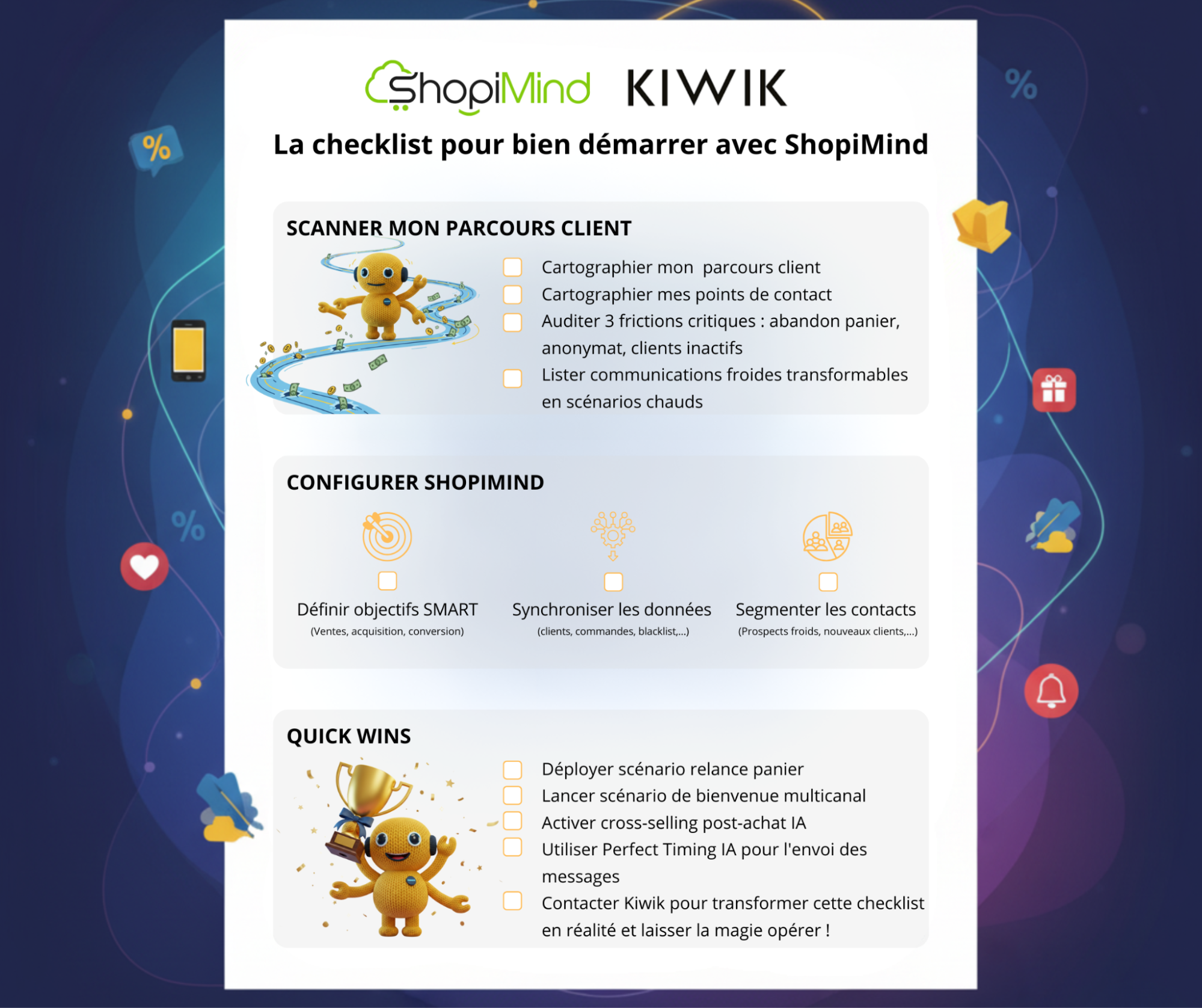
☑️ Map your customer journey
☑️ Map all contact points
☑️ Audit the 3 key friction points: cart abandonment, anonymity, inactive customers
☑️ List cold communications to transform into warm workflows
II. Setting Up ShopiMind: The Non-Technical Checklist
First things first: Automation must be measurable! That’s why it’s essential to set clear, quantifiable (SMART) objectives before launching your campaigns.
- Sales Goals: Set a target percentage of total revenue generated by automation campaigns within a given period.
- Acquisition Goals: Aim for growth in your subscriber list (e.g., increase your email list by 10% per quarter).
- Conversion Goals: Reduce cart abandonment rate by targeting a specific recovery rate.
Data is Your Fuel: Synchronization and Quality
The power of ShopiMind, enhanced with [[artificial intelligence]] , relies on how complete and high-quality your data is. Make sure data sync is comprehensive. Partner expertise (like Kiwik) is critical for building a strong and reliable data foundation.Segment Like a ProSegmentation is about turning real customer needs into targeted marketing actions. Automation should feel personal, not robotic. If the message is relevant, customers will appreciate it!
Fundamental segments: A fast launch requires building basic segments: cold prospects (subscribers who haven’t purchased), cart abandoners (the most urgent group), new customers, and inactive clients.
The benefit of active listening (dynamic segmentation): ShopiMind’s AI can automatically create ultra-precise segments based on queries or keywords, allowing you to reach the right person at the right time.
Multichannel Deployment: The 5 Channels That Build Bridges
ShopiMind is a multichannel platform offering five channels for an effective omnichannel strategy. Channel activation should be strategic, fitting the urgency and context of each message.
Email:
The core channel for retention, rich content, and longer cycles (newsletters, birthday flows).

- SMS: Your channel for proximity and urgent notifications. Perfect for high-value cart recovery or vital alerts, ensuring direct and impactful mobile contact.
- Pop-in: Essential for instant acquisition (GDPR-friendly lead capture) or preventing abandonment (exit intent pop-ins).
- Push Notification: Targets anonymous visitors and re-engages your mobile audience without relying on the inbox.
- Smart On-site Content: Your real-time conversion channel. Display hyper-personalized content, AI-powered recommendations, or reassurance messages right on your site, based on browsing behavior.
☑️ Set SMART goals
☑️ Synchronize your data
☑️ Segment your contacts - III. Quick Wins That Pack a Punch Your strategy is set, your tool is ready. Now it’s time to launch your most impactful workflows.
The Welcome Scenario: Create Instant Connection (Acquisition)
Welcome flows are the first warm touchpoint post-signup or account creation. They deliver outstanding open and engagement rates.
Cart Abandonment: Recover Lost Revenue (Conversion)
Cart abandonment is often the top urgency in e-commerce. Pro merchants—especially in B2B, where carts are 7x bigger than in B2C—need to act fast. Data shows the majority of recovered sales happen within the first few hours.
Retention Powered by AI: Surgical Cross-Selling
After a purchase, the main objective is to maximize lifetime value and drive repeat purchases. Cross-selling must switch from generic to laser-focused—thanks to ShopiMind’s artificial intelligence.
💡 Customer Case Study:
For
GROUPE NUM’AXES
, one of our e-commerce clients, switching to more granular segment activation and scenario triggers intensified engagement without causing email fatigue. Post-optimization, personalized daily email volumes doubled. At the same time, key indicators (open rates, click-through rates) improved, resulting in a significant rise in both sales and revenue generated directly via ShopiMind.High-quality, relevant messaging increases how much communication your customers welcome, turning automation into a powerful lever for performance and loyalty. ☑️ Launch cart recovery scenario
☑️ Roll out multichannel welcome flow
☑️ Activate AI-powered cross-sell after purchase
☑️ Use AI Perfect Timing for message sending
☑️ Contact Kiwik to turn this checklist into reality and let the magic happen!
IV. The Conversion Tone: Clarity and Impact
ShopiMind’s technical excellence isn’t enough. The message and tone—that’s what builds real human connection.
"Why" Before "What": Make It About the Customer
To influence behavior without causing friction, speak to the customer’s needs. Every automated communication should focus on solving pain points or adding real value for your customer—not just driving your bottom line.
For cart reminders, instead of just stressing the urgency to buy, focus on helping the customer complete their project. Always use a courteous, respectful tone—even in automation, quality customer service remains key. Post-purchase emails should act as "constructive feedback," showing appreciation for the customer’s loyalty or purchase history.
Make Your Message Memorable
In a crowded digital landscape, only a select few messages cut through or go viral—and those are usually sharp and direct. That’s the secret ingredient for subject lines and CTAs that get attention.
ShopiMind’s AI Assistant: Your Stylistic Co-pilot
ShopiMind’s artificial intelligence is a crucial asset to ensure your message keeps a clear, impactful tone at scale—not just with recommendations, but with fresh creative too.
Content Optimization:
Generative AI can craft punchy subject lines or reword headlines and text content for maximum impact, tailored to fit your brand’s style.
- Perfect Timing: Even the best message is wasted if it lands at the wrong time. ShopiMind’s perfect timing feature uses AI to send your campaigns (email, SMS, push) at the optimal time for your audience, ensuring your message hits when they're most likely to engage—maximizing perceived relevance.
- Conclusion: Move Into Action! Marketing automation is strategic and relational necessity. Effectiveness comes from mastering your customer journey—and identifying the key friction points.
Your ShopiMind strategy should start by executing your quick wins. Deploying multichannel touchpoints, powered by AI, lets you transform your site data into ultra-personalized conversations.
Download the key steps checklist to get started with ShopiMind or optimize your current strategy ⬇️
An expert partner like Kiwik ensures your technical foundation is solid and also
guides you from A to Z with ShopiMind implementation
: Together, we identify missing communications in your customer journey, create the workflows (including design and content), and continually optimize for long-term performance.
👉 Schedule a call with our experts to maximize your ShopiMind ROI. Book an appointment with Kiwik
Marketing Automation: Starter Checklist for ShopiMind
Related Articles
Boosting your average order value is one of the most [...]

Email marketing is an incredibly effective marketing tool for every [...]